Friday, January 9, 2015

Insects of 2014: Lepidoptera

I was pleasantly surprised when I looked back through the many thousands of photos I took in 2014. It was a great year, my first as a mother, but also I was happy to discover I did manage to take a considerable number of photos of insects (and other invertebrates). It's rather wintery and considerably devoid of bugs and color right now, aside from the birds flitting back and forth urgently to our feeder. But that led me to the idea to share some of the photos of insects I did manage to snap in 2014. I'll start with a charismatic group, the Lepidopterans- butterflies, moths and their caterpillars.

The order Lepidoptera is fairly well known by people, because butterflies and moths are considered beautiful and appealing. Their life cycles are studied in school and many people know that caterpillars become butterflies. The monarch butterfly, which I'll write about later, is a special case of a migrating insect, and unfortunately are in decline due to habitat loss and pesticide use. The photos I did try to take of them - as they flew by on their way to Mexico - are not worth sharing, but I did see some.


The Zebra Swallowtail caterpillar Eurytides marcellus feeds on Paw-Paw. These adults were flitting about on a filed of clover, drinking nectar.


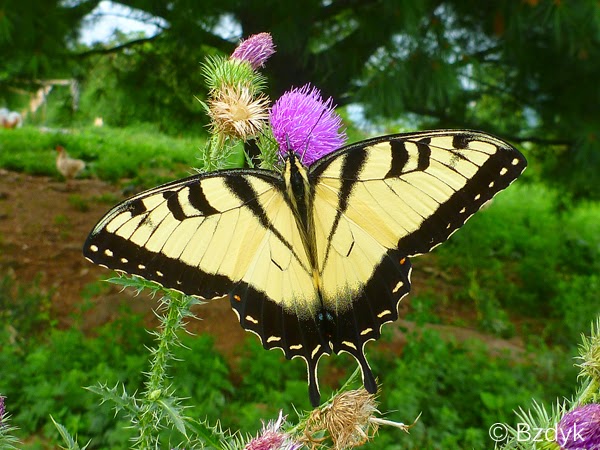
These tiger swallowtails Papilio glaucus were very cooperative and I managed to get a lot of good shots. They are seen feeding on thistle and the same feild of clover as the zebra swallowtails. The upper photo is a female, distinguished by the blue markings on the hindwings. Females can also be black. The lower photo shows a male, which are always yellow, and have a dark black area on the hindwing.


These photos are of the colorful Black Swallowtail caterpillar Papilio polyxenes on some dill. The caterpillar has a fun defensive technique of revealing two orange tentacle protrusions and producing a foul smell (that I couldn't detect) when disturbed.


While out on a walk I encountered this fuzzy Salt Marsh caterpillar Estigmene acrea. It was likely looking for a hiding place to pupate and overwinter.


This caterpillar is the common buckeye Junonia coenia. Note the metallic blue spines!


This interesting looking larva is a White-marked Tussock Moth caterpillar Orgyia leucostigma. These are known to cause allergic reactions so it's probably better to look and not touch.


This is the Banded Tussock Moth Halysidota tessellaris on a Japanese maple leaf. These caterpillars may also have irritating hairs.

I definitely have a soft spot for caterpillars, and spent many hours of my childhood searching for them and attempting to rear them. For an amausing story about one of those attempts, you should check out an article I wrote for the publication 'Habitat Herald'. My article appears near the end of the pdf: http://www.loudounwildlife.org/PDF_Files/Vol_19_Issue_2.pdf

And last but not least, here is Hemaris diffinis  a hummingbird moth or Snowberry Clearwing.


This photo does not do this fascinating moth justice. It hovers gracefully around flowers, and is a mimic of bees and one I have worked with before. I happen to have three renderings (pencil, ink and wash) that I did in an undergraduate scientific illustration course, which attests to how much time I spent on this insect at one time. The pen and ink stippling alone took over 10 hours to complete!


Thursday, January 8, 2015

Remembering the bees

To ease myself back into thinking and writing about such things as bees and my "old life", I will share another small reminder of when I was an artist and an entomologist.

A tiny illustration of mine  which I did a few years ago for one of my mentors (Robbin Thorp) in grad school appears in this fantastic book. He sent me a copy and as I flipped through the pages, I remembered how much I missed those bees.

http://www.amazon.com/California-Bees-Blooms-Gardeners-Naturalists/dp/1597142948

Since I last posted, I gained my certification as a master naturalist and became a mother. So of late, I am primarily a parent and seldom get the chance to use my brain to think about insects. But every once and a while a friend or family member will inevitably have a 'bug question' and shoot me a text or email or inquire in casual conversation and I always jump at a chance to help out and share my knowledge when I can. This is an attempt to revive that part of my life again by sharing my thoughts and encounters with the natural world once again, here.


Thursday, January 24, 2013

Published! I discovered a new bee!

It's been too long.

I never wrote about my new bee species I discovered: megachile pankus
http://www.pensoft.net/journals/zookeys/article/3234/abstract/a-revision-of-the-megachile-subgenus-litomegachile-mitchell-with-an-illustrated-key-and-description-of-a-new-species-hym

I chose Zookey as my journal because it is open access. Anyone can view and download my paper. It feeling amazing to have discovered, described, and named a new species. My name gets to stay with this bee, one way or another, forever. I feel like I made my mark.

I am constantly tempted by the art world as well, as always. I absolutely love photography. I have several cameras, and I never get tired of snapping shots wherever I go. I'm very happy I got to incorporate my artwork into my thesis by creating these illustrations of my bees. Hopefully the guide I developed will help others identify these bees.


Wednesday, September 14, 2011

Degree


After some soul searching, I've decided to get a Masters instead of a PhD. I'm pleased with this choice. I may forego the world of academia, and instead head back east for a more 9 to 5 type job, using my insect identification skills to perhaps be a regulatory entomologist. This means I will no longer be taking a qualifying exam, and will be cutting out my unsuccessful trap nesting study to focus on morphology and molecular data for my revision of Litomegachile.


Tuesday, May 10, 2011

While databasing bumblebees, I come across one with a plastic bubble on its butt. Butt protector? It makes me laugh.

Wednesday, April 6, 2011


A tiny parasitoid in my yogurt, right before I got engaged.

Wednesday, March 23, 2011


Interesting flies, out and about.