Tuesday, January 13, 2015

Insects of 2014: Arachnids

Spiders are not insects of course. They belong to the Class Arachnida (Arachnids). But they are small and interesting to encounter and photograph never-the-less.


I often photograph jumping spiders, they have a special sort of personality almost, the way they look right at you. They belong to the family Salticidae.


Gasteracantha cancriformis - Spinybacked Orbweaver. The small fluffs on the web in front of the spider are apparently added purposely by it to act as a sort of visual warning for birds.


Daddy-long-legs is what I have always called them. Others call them harvestmen. They are more closely related to scorpions than spiders.

Insects of 2014: Odonata, Phasmatodea, and Orthoptera

Back to the past year's insects. I have grouped these three orders together because I saw only one or two representatives of each.


The walking stick - named for obvious reasons - can be very difficult to spot out in the woods. This one is fairly obvious on the side of a building. I have an entomologist friend who was in my lab in grad school who studies Phasmatodea digestive systems. In the museum we both worked in there were several walking stick colonies, including some very interesting species.


Here's a pretty blue damselfly resting by the side of a lake. Damselflies and dragonflies belong to the order Odonata.

Orthoptera includes grasshoppers and crickets.


This cryptic (camouflaged) Atlanticus sp. shieldback is a female. You can tell by the large sword-like ovipositor which she uses to lay eggs.


This little grasshopper is a nymph, which means it has several more instars, or growth phases, to go through before it is an adult. After hemimetabolous insects hatch from an egg, they look much like a mini adult. Nymphs do not have wings and cannot reproduce, those things come to it after the final molt into an adult. All the insects on this page are hemimetabolous, as are the Hemiptera (bugs) I posted about a few days ago. The other kind of development is holometablous, which includes insects such as butterflies and beetles. These insects go through a complete metamorphosis, where the young insect is a larva and does not look like the adult. In the final stage before adulthood the holometabolous insect pupates to make the dramatic change, and emerges as an adult.


Monday, January 12, 2015

Dermestid beetles and how to make an insect collection


Today I wanted to take a break from looking back at insects of 2014 and address an insect that I am often asked about.

As we played with our babies at a mom group, a friend of mine wanted to know what the small insects she found in her bathroom were. She gave me a description and I guessed they might be beetles in the family Dermestidae or 'carpet' beetles. The small woolly larvae feed on organic matter such as hair and unfortunately that includes wool clothing. They and the adult tiny brown beetles are fairly ubiquitous in homes. Another friend recently asked what may have eaten the dead beetle specimen she was saving on a windowsill. Dermestids also eat dead insects. It's a good thing they do, or else we'd have a lot more dead bugs hanging around! But if you want to save the insects you find you'll have to take steps to keep the carpet beetles out.


A larval Dermestid beetle, probably Anthrenus verbasci. They are only a few millimeters long, about half the size of a grain of rice.


For entomologists, these beetles can be a serious threat to collections. Special effort is taken to protect collections by use of special drawers with tight fitting lids and use of insecticides. At the museum I worked in during grad school we had a "fumigation cabinet" where any new insects to be added to the collection would spend time in a chemical cloud to eliminate any hitchhikers from infesting the whole collection. Another way to treat insect collections at home is to freeze them and then place them in a tight fitting container made of plastic or wood. Adding a few moth balls can't hurt if you live in a moist climate where mites and other tinier arthropods can squeeze in.


A collection of Osmia bees is stored safely in a drawer within a cabinet to prevent Dermestid infestation.

Also in grad school I took part in a project that aimed to share the tools and processes of insect collection via instructional videos. These 'how to" videos show viewers how to collect, process and curate their own insect collections. We wrote scripts and filmed and edited these videos and published them online. It was a lot if fun and hopefully useful to aspiring insect collectors out there. In some of these videos you'll get to see me (well, my hands) collect beetles, dig holes and pin insects! If you'd like to view them, they can be found here:


Sunday, January 11, 2015

Insects of 2014: Coleoptera

The Beetles! Coleoptera. Beetles are another well known group of insects. They are also the largest of the insect orders, with at least 400,000 species described. Here are some that I ran into in the past year:


This beautiful green beetle is the Fiery Searcher Calosoma scrutator. It is a large ground beetle which hunts other insects. But this one I found out of it's normal setting, in a department store among the clothing aisles. And it wasn't the only one! I saw others of the same kind. They must have hitchhiked on a shipment of something I did my best to inconspicuously "shoplift" the beetle out of the store in my purse but it kept escaping through a hole in the zipper. Once I got it home I was able to snap this photo and find out what it was. Then I let it go in the garden where it hopefully found things to eat.


Alaus oculatus, the Eastern-Eyed Click Beetle was seen sitting on a log on one of my walks. These large click beetles like others in the family Elateridae, have the ability to right themselves by flicking a joint and catapulting themselves into the air.


This Giant Stag Beetle Lucanus elaphus was dead on the side of the road when I found it. I took its picture because I was impressed with its giant size. You can see here an ant had already started to take an interest in it.


This beetle is probably in the Subfamily Dynastinae - the  Rhinoceros Beetles. The females do not have the showy horns that the males possess.


This Banded Net beetle Calopteron reticulatum may look like a moth, but it is actually a beetle.


These are Japanese beetles  Popillia japonica, a notorious garden pest. But these two struck me as quite intriguing as they sat together, almost like they were having a little conversation.


A firefly Photinus sp. hiding out during the day under a leaf.


The Goldenrod Soldier Beetles Chauliognathus pennsylvanicus were all over the flowers on this fall day. 

Saturday, January 10, 2015

Insects of 2014: Hemiptera

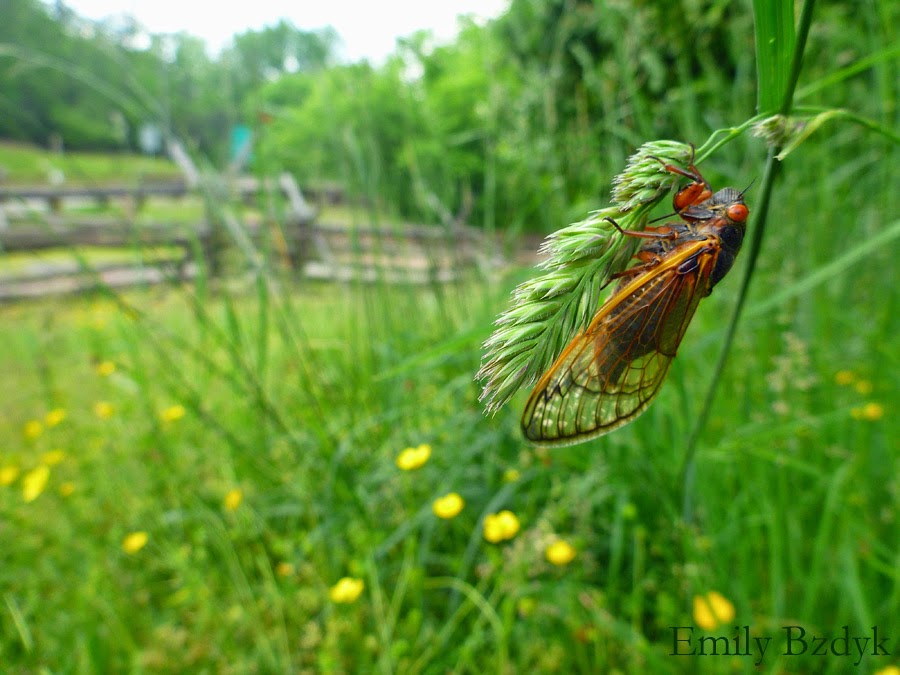
Hemiptera are the "true bugs". Though people commonly refer to all insects and indeed other invertebrates as "bugs" the bugs are actually a group of insects that includes stink bugs, cicadas, bed bugs, assassin bugs and aphids to name just a few. In the past decade or so Brown Marmorated stink bugs have become fairly infamous in many areas of the United states due to their habit of home invasion during the winter months. Cicadas also make press when the periodical cicadas emerge en masse in the summer months in certain areas.
The infamous periodical cicada Magicicada sp. in 2013. 

Here are some of the bugs I found in the past year:


These beauties are Florida Predatory Stink Bugs Euthyrhynchus floridanus. Unlike many stink bugs, (including the invasive Brown Marmorated stink bug) that feed on plants, these stink bugs eat other bugs. The can be gregarious and even attack large prey together.


In an amusing (well, to me anyway) intersection of my two worlds, a stink bug, perhaps a Brown Marmorated, laid eggs on my nursing cover while it hung outside on the line to dry. I collected these eggs to observe them until they hatched to see what they were.


This is a broad-headed bug, probably in the Subfamily Alydinae. They feed on seeds and the nymphs of some species are ant mimics, living in ant nests.


Here is a cicada, one of the annual species, emerging from it's larval exoskeleton. It chose my car tire as a safe spot to eclose and wait for its new adult exoskeleton to harden and darken. Luckily I didn't need to go anywhere.

Friday, January 9, 2015

Insects of 2014: Lepidoptera

I was pleasantly surprised when I looked back through the many thousands of photos I took in 2014. It was a great year, my first as a mother, but also I was happy to discover I did manage to take a considerable number of photos of insects (and other invertebrates). It's rather wintery and considerably devoid of bugs and color right now, aside from the birds flitting back and forth urgently to our feeder. But that led me to the idea to share some of the photos of insects I did manage to snap in 2014. I'll start with a charismatic group, the Lepidopterans- butterflies, moths and their caterpillars.

The order Lepidoptera is fairly well known by people, because butterflies and moths are considered beautiful and appealing. Their life cycles are studied in school and many people know that caterpillars become butterflies. The monarch butterfly, which I'll write about later, is a special case of a migrating insect, and unfortunately are in decline due to habitat loss and pesticide use. The photos I did try to take of them - as they flew by on their way to Mexico - are not worth sharing, but I did see some.


The Zebra Swallowtail caterpillar Eurytides marcellus feeds on Paw-Paw. These adults were flitting about on a filed of clover, drinking nectar.


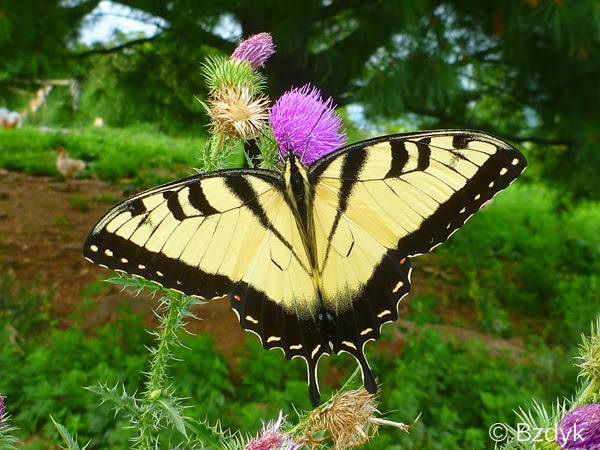
These tiger swallowtails Papilio glaucus were very cooperative and I managed to get a lot of good shots. They are seen feeding on thistle and the same feild of clover as the zebra swallowtails. The upper photo is a female, distinguished by the blue markings on the hindwings. Females can also be black. The lower photo shows a male, which are always yellow, and have a dark black area on the hindwing.


These photos are of the colorful Black Swallowtail caterpillar Papilio polyxenes on some dill. The caterpillar has a fun defensive technique of revealing two orange tentacle protrusions and producing a foul smell (that I couldn't detect) when disturbed.


While out on a walk I encountered this fuzzy Salt Marsh caterpillar Estigmene acrea. It was likely looking for a hiding place to pupate and overwinter.


This caterpillar is the common buckeye Junonia coenia. Note the metallic blue spines!


This interesting looking larva is a White-marked Tussock Moth caterpillar Orgyia leucostigma. These are known to cause allergic reactions so it's probably better to look and not touch.


This is the Banded Tussock Moth Halysidota tessellaris on a Japanese maple leaf. These caterpillars may also have irritating hairs.

I definitely have a soft spot for caterpillars, and spent many hours of my childhood searching for them and attempting to rear them. For an amausing story about one of those attempts, you should check out an article I wrote for the publication 'Habitat Herald'. My article appears near the end of the pdf: http://www.loudounwildlife.org/PDF_Files/Vol_19_Issue_2.pdf

And last but not least, here is Hemaris diffinis  a hummingbird moth or Snowberry Clearwing.


This photo does not do this fascinating moth justice. It hovers gracefully around flowers, and is a mimic of bees and one I have worked with before. I happen to have three renderings (pencil, ink and wash) that I did in an undergraduate scientific illustration course, which attests to how much time I spent on this insect at one time. The pen and ink stippling alone took over 10 hours to complete!


Thursday, January 8, 2015

Remembering the bees

To ease myself back into thinking and writing about such things as bees and my "old life", I will share another small reminder of when I was an artist and an entomologist.

A tiny illustration of mine  which I did a few years ago for one of my mentors (Robbin Thorp) in grad school appears in this fantastic book. He sent me a copy and as I flipped through the pages, I remembered how much I missed those bees.

http://www.amazon.com/California-Bees-Blooms-Gardeners-Naturalists/dp/1597142948

Since I last posted, I gained my certification as a master naturalist and became a mother. So of late, I am primarily a parent and seldom get the chance to use my brain to think about insects. But every once and a while a friend or family member will inevitably have a 'bug question' and shoot me a text or email or inquire in casual conversation and I always jump at a chance to help out and share my knowledge when I can. This is an attempt to revive that part of my life again by sharing my thoughts and encounters with the natural world once again, here.